The human layer of the network state: why technology won't replace trust
A network state doesn't begin with territory. It begins with an idea and a community of people who share common values and are ready to act together.
First, such a community forms online. Then it creates its own rules, digital tools, economic relationships and the capacity for collective action. Over time, the digital network can acquire physical form in the shape of campuses, public spaces, settlements and distributed territories.
In the concept of The Network State, a network state is described as the sequential development of a startup society: an online community gains the capacity for joint action, builds physical infrastructure and gradually transforms into a more complex social system.
We at SPACEHUMAN see enormous potential in this idea. But at the same time we see a question, on the answer to which the sustainability of any new society may depend:
What people will make decisions in it and what qualities, goals and principles will guide them?
Technology can help people unite. But it doesn't create trust, responsibility and a culture of cooperation automatically.
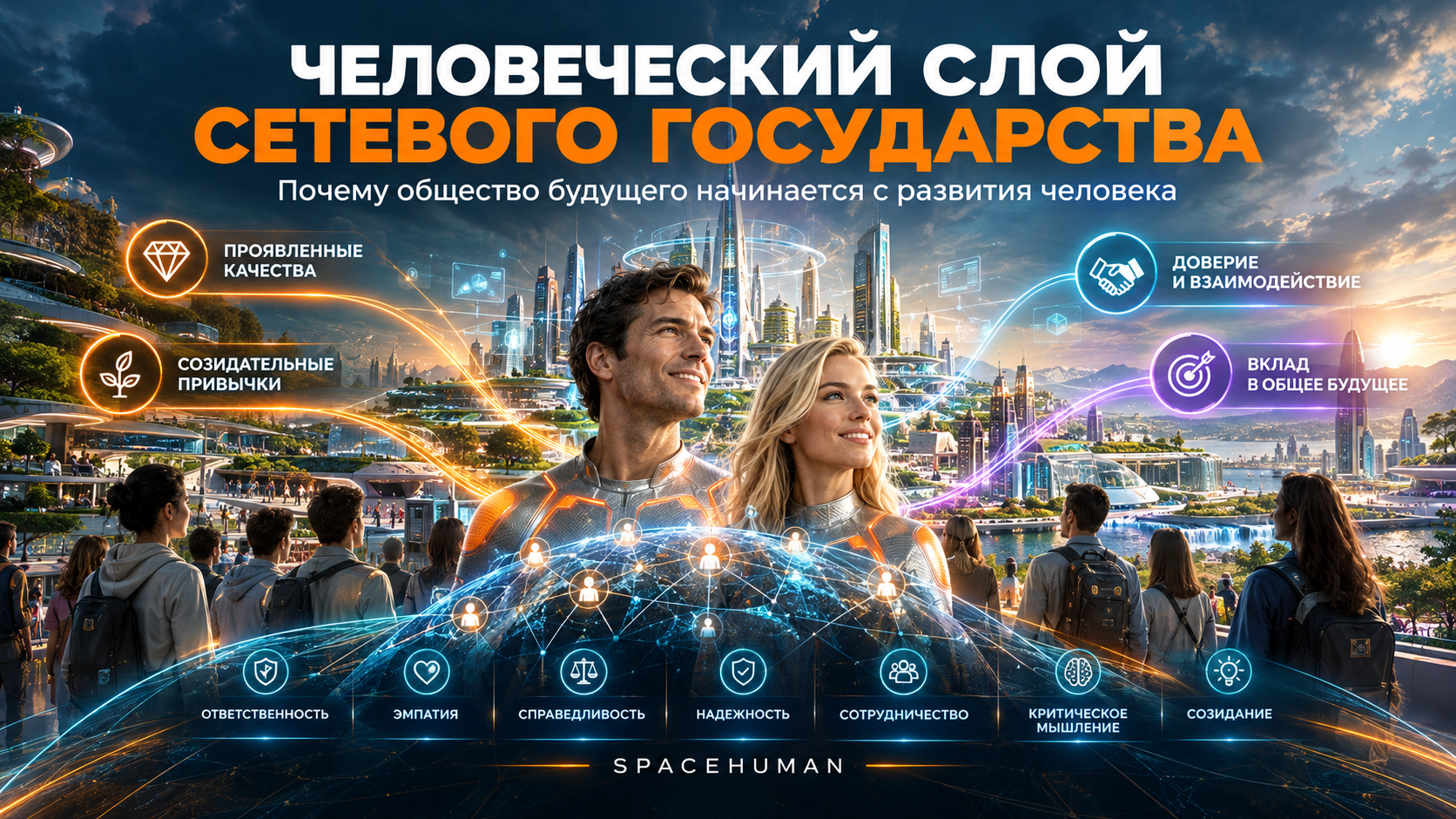
That's precisely why a network state needs a human layer.
What we call the human layer
The human layer of a network state is a system of values, qualities, habits, relationships and reputation mechanisms that determine the behavior of community members.
Digital infrastructure answers the questions:
- how to verify identity;
- how to conduct a vote;
- how to record a transaction;
- how to distribute authority;
- how to preserve the history of decisions;
- how to ensure formal conditions are met.
The human layer answers different questions:
- who are participants ready to trust;
- who is capable of making responsible decisions;
- how does a person behave in a difficult situation;
- is he able to consider the interests of others;
- is he ready to acknowledge his own mistake;
- what does he create for the community;
- does he strive for the common good or only for personal gain;
- how does his behavior affect those around him;
- does his actual contribution match the stated values.
We believe that technology and the human layer should develop simultaneously.
Without technology, it's hard to coordinate a large distributed community. But without developed people, even a perfect system can start being used in the interests of individual participants.
Pain 1. Shared values do not guarantee identical behavior
Creators of a new community usually start with a unifying idea.
Participants may share an interest in decentralization, entrepreneurship, freedom, education, longevity, technology, or sustainable development.
However, agreement with a manifesto does not yet mean readiness to live in accordance with it.
A person may support freedom but avoid responsibility for the consequences of their own decisions.
May advocate for transparency but hide mistakes when they threaten their position.
May speak of cooperation but view other participants only as a resource for achieving personal goals.
May support justice as long as a fair decision does not contradict their interests.
Therefore, there is always a potential gap between declared values and everyday behavior.
SPACEHUMAN proposes to work precisely with this gap.
We view development as a sequence:
Values → qualities → habits → actions → contribution → trust → reputation → community culture
Values show direction.
Qualities determine a person's ability to follow the chosen direction.
Habits turn principles into sustainable behavior.
Actions make personality visible to others.
Contribution shows real benefit to the community.
Trust arises from repeated interaction experience.
Reputation helps understand what to expect from a person.
And community culture is built from the behavior of all its participants.
Thus shared values cease to be merely a beautiful declaration and begin to manifest in real life.
Pain 2. Key decisions are still made by people
In a network state, Web3, blockchain, DAO, smart contracts, digital identity and other decentralized governance tools may be used.
Such technologies can make some processes more transparent and allow participants to verify actions, rights or achievements.
But a technological system does not determine the quality of the goal for which it is used.
A DAO can count votes. But it cannot guarantee the foresight of a decision.
A smart contract can execute pre-set conditions. But it does not determine whether those conditions were fair.
Blockchain can preserve a history of actions. But the immutability of a record does not mean the accuracy of its original interpretation.
Digital reputation can show completed projects or contribution to the community. But it should not assign a person a final value.
Behind every protocol, rule and algorithm are people.
And their qualities determine:
- what goals will be set;
- whose interests will be considered;
- how common resources will be distributed;
- how the community will treat weaker members;
- whether an error will be acknowledged;
- what will matter more, quick profit or long-term sustainability;
- whether power will become a form of responsibility or a privilege.
SPACEHUMAN systematically works with qualities that influence such decisions:
- responsibility;
- honesty;
- fairness;
- empathy;
- decisiveness;
- independence;
- critical thinking;
- reliability;
- self-control;
- ability to cooperate;
- orientation toward creation.
On the official SPACEHUMAN website, trust is already defined as the most important resource of future society, and the project's system connects it with honesty, responsibility, empathy, discipline, reliability, and other personal qualities.
We are not proposing to replace human decision-making with an algorithm. We are proposing to develop the human who makes that decision.
Pain Point 3. Selecting strong participants does not replace their development
Creators of network states and startup societies seek to unite initiative-taking, independent, and technologically advanced people.
Such selection can give a community a strong start. But it does not solve all future problems.
A person is not an unchanging set of characteristics.
Even a talented specialist can:
- struggle with teamwork;
- avoid difficult conversations;
- handle responsibility poorly;
- prioritize personal status over community results;
- fail to notice the emotional consequences of their own behavior;
- lose the ability to cooperate in conflict;
- overestimate their own contribution;
- resist feedback.
Therefore, a community cannot simply search for already-formed "ideal participants".
What is needed is a culture in which development continues after joining the community.
SPACEHUMAN creates a system that helps a person:
- better understand their own qualities;
- choose a direction for development;
- turn a quality into concrete actions;
- form constructive habits;
- analyze their interaction with others;
- see the connection between behavior and consequences;
- notice the contributions of other participants;
- receive feedback;
- confirm changes through real actions.
In this model, human development becomes not a private hobby, but part of the resilience of the entire community.
Pain Point 4. Contribution is not always visible, and activity is not always useful
In the digital environment, it is easiest to measure what leaves a clear trace:
- number of publications;
- frequency of voting;
- financial transactions;
- number of completed tasks;
- audience size;
- volume of invested funds.
But these metrics do not always reflect a person's contribution.
One participant may constantly appear in discussions but fail to bring initiatives to completion.
Another may speak rarely but help newcomers, prevent conflicts, preserve knowledge, and maintain the common space.
A third creates a sought-after product.
A fourth brings together people without whom the product would not have emerged.
For a sustainable community, it is important to learn to notice not only loud activity, but also real value.
Therefore, we define SPACEHUMAN's reputation formula as follows:
Reputation = demonstrated qualities + habits + emotional impact + contribution to the world
Demonstrated qualities show how a person acts in specific situations.
Habits allow us to distinguish a random action from a sustained pattern of behavior.
Emotional impact reflects the experience that other people gain in their interaction with the participant.
Contribution to the world shows what became better because of their actions.
Such reputation does not reduce a person to a single number. It helps to see their role in the context of a specific community.
Pain 5. Reputation can become a tool of trust or control
Any new society needs reputation mechanisms.
Without them, it's hard to understand:
- who to trust with resources;
- who fulfills commitments;
- who is capable of leading a project;
- who creates systemic contribution;
- who is ready to answer for the consequences of decisions.
Web3 opens up possibilities for portable digital credentials, resilient identity, and verification of individual achievements.
But here lies an important ethical boundary.
Confirmation of a specific fact should not turn into an absolute assessment of a person.
A person is not equal to:
- the result of one test;
- the opinion of one participant;
- a past mistake;
- the number of tokens;
- the number of votes;
- a single reputation score.
We believe that a reputation system should be:
- multidimensional;
- contextual;
- explainable;
- tied to specific actions;
- protective of personal data;
- open to feedback;
- preserving the right to correction;
- accounting for a person's capacity to change.
Web3 can help verify contribution. But technology should not determine the ultimate value of a person.
What SPACEHUMAN offers to creators of new societies
We address those who are creating network states, startup societies, Web3 communities, and cities of the future.
You are designing new ways to coordinate people.
Creating technological, economic, and physical infrastructure.
Developing rules, institutions, and models of shared life.
We offer to add a human layer to them.
SPACEHUMAN helps build a system where:
- • shared values find expression in behavior;
- • qualities develop consciously and consistently;
- • habits support community culture;
- • contribution becomes visible;
- • trust forms based on experience;
- • reputation reflects actions, not popularity;
- • a person gains the ability to change;
- • personal development strengthens the entire society.
When responsibility becomes a habit, the need for constant control decreases.
When honesty shows up in difficult situations, trust strengthens.
When a person knows how to manage their own selfishness, decisions become more balanced.
When empathy connects with fairness, the community resolves conflicts better.
When participants are oriented toward creation, shared resources turn into new opportunities.
This is how a person's inner development becomes a public asset.
The future is determined not only by system architecture
A network state can start with an idea.
You can create a digital economy, governance mechanisms, Web3 infrastructure, and physical spaces.
But key decisions will still be made by people.
It is people who will determine how technology is used.
It is their goals that will influence the distribution of resources.
It is their principles that will set the boundaries of what is acceptable.
It is their qualities that will determine whether the new society becomes sustainable, fair, and creative.
We at SPACEHUMAN believe:
Technologies create the infrastructure of the future. Developed human qualities fill it with meaning and determine the direction of development.
Therefore, the human layer cannot be added after construction is complete.
It must be created from the very beginning.
Not as a control system.
Not as a selection of the "worthy".
Not as a new social rating.
But as a culture in which people consciously develop their best qualities, interact based on shared values, make contributions and strengthen trust.