
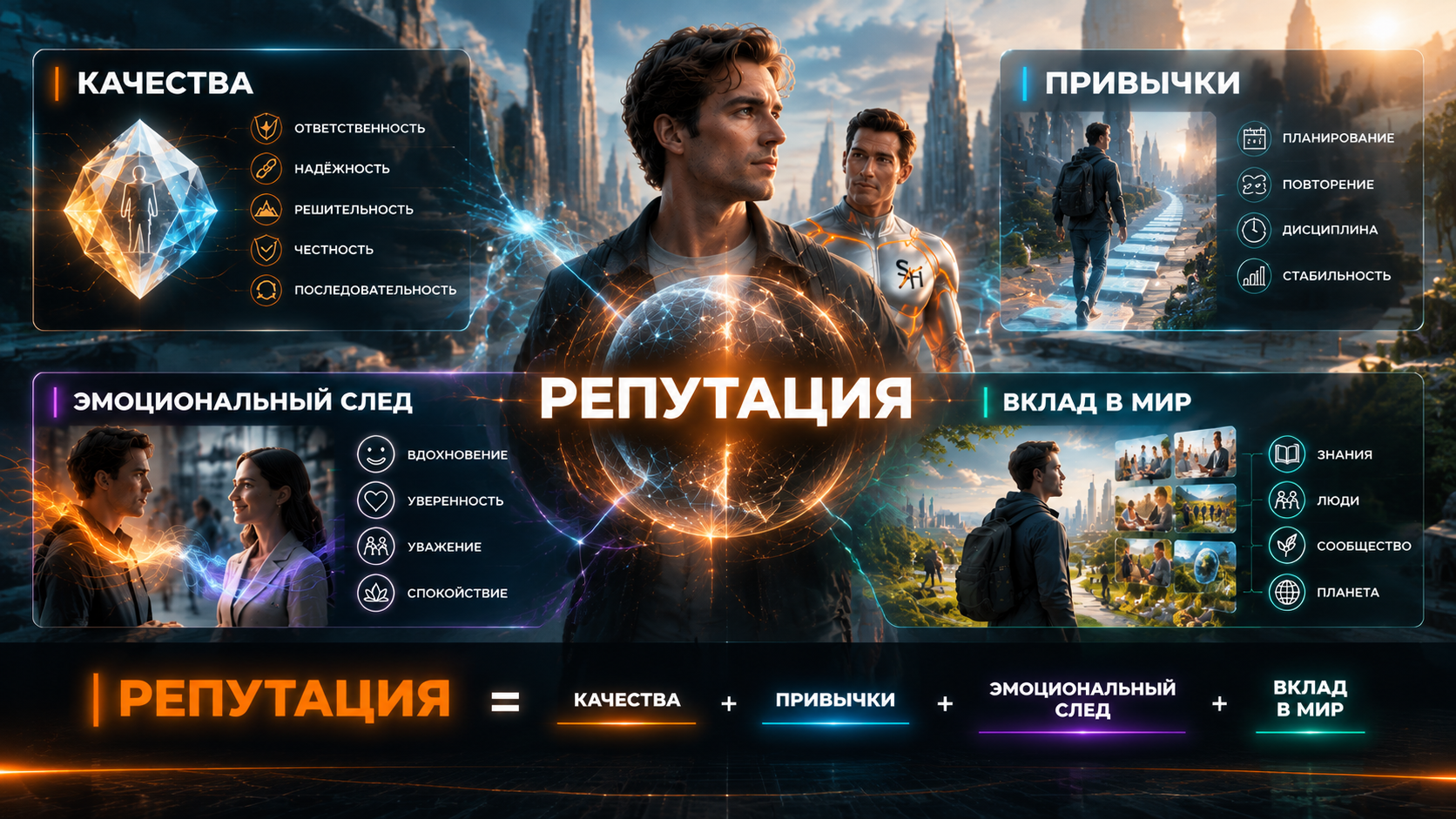
A Person's Reputation: SPACEHUMAN's Perspective
We are used to evaluating a person by what is easy to see and measure: profession, position, income, fame, number of followers, and achievements.
This information can tell much about a person's social or professional standing. But it does not answer a more important question:
What experience do people gain from interacting with them, and what can be expected from them in the future?
The answer to this question forms reputation.
SPACEHUMAN views reputation not as popularity, external image, or a final assessment of personality. For us, reputation is a dynamic history of how a person's qualities manifest in their everyday behavior, relationships with others, and the contribution they create in the world.
SPACEHUMAN's Reputation Formula
We propose viewing reputation through four interconnected components:
Reputation = demonstrated qualities + habits + emotional impact + contribution to the world
This formula helps you see a person more deeply than a resume, social media profile, or a single review.
Let's examine each component.
1. Demonstrated Qualities
Responsibility, honesty, reliability, decisiveness, discipline, fairness, empathy, and respect affect a person's reputation in different ways.
However, qualities become noticeable to others only when they manifest in concrete actions.
It is not enough to consider yourself responsible. Responsibility is confirmed by the fact that a person:
- fulfills commitments;
- warns about potential problems;
- takes responsibility for the consequences of their decisions;
- does not shift blame to others;
- sees things through to completion.
It is not enough to call yourself honest. Honesty manifests in the ability to tell the truth, acknowledge mistakes, and remain true to principles even when it is inconvenient.
Decisiveness becomes visible in situations of uncertainty. Reliability is tested in difficult circumstances. Empathy manifests in the ability to consider another person's state and interests.
A quality affects reputation only when it transforms into action.
At the same time, one action does not describe a person's entire personality. Reputation forms gradually, as experience of interaction accumulates.
2. Habits
If qualities show what a person is capable of being, then habits demonstrate how they behave regularly.
Anyone can be late once. But constant lateness creates the expectation that a person does not respect others' time.
It is easy to help a colleague once. But the habit of noticing other people's difficulties gradually forms the reputation of an attentive and responsive person.
Reputation is influenced by everyday actions:
- does the person honor agreements;
- do they keep promises without constant oversight;
- do they respond to important messages;
- do they return what they borrowed;
- do they express gratitude for help;
- do they support others in difficult situations;
- do they care for shared spaces;
- do they acknowledge their own mistakes;
- do they share knowledge;
- do they complete work to completion.
A single action can be a coincidence. A repeated action becomes a pattern of behavior.
Habits transform a person's inner qualities into a stable and observable part of their reputation.
3. Emotional Impact
After interacting with a person, more than just information about their words and actions remains. Those around them retain a certain emotional state.
Around one person, people feel calm, respect, and confidence. Around another, tension, anxiety, or a sense of being devalued arises.
Emotional impact is formed through:
- tone of communication;
- attention to the other person;
- reaction to someone else's mistake;
- respect for personal boundaries;
- behavior in conflict;
- ability to listen;
- gratitude;
- support;
- fairness;
- sincerity.
A positive emotional impact does not mean a person must always agree, avoid difficult conversations, or try to please everyone.
You can refuse without humiliating the other person.
You can criticize while maintaining respect.
You can set boundaries without aggression.
You can make unpopular decisions and honestly explain their reasons.
Therefore, what matters is not only what a person said or did, but also what experience of interaction other people gained.
Over time, this experience becomes part of their personal, professional, and social reputation.
4. Contribution to the World
Reputation depends not only on a person's character and manner of communication. What matters is the value they create.
Contribution to the world can take many forms:
- quality work completed;
- a useful product;
- a created project;
- knowledge shared;
- mentorship;
- family support;
- help to another person;
- community development;
- responsible attitude toward shared resources;
- solving a social problem;
- creating new opportunities for others.
Contribution does not have to be large-scale or public. Not every person must make a discovery or build an international company.
Sometimes a meaningful contribution is the ability to support another person, unite a team, share experience, create an atmosphere of trust, or responsibly complete your part of a common task.
It is useful to ask yourself:
What becomes better because of my actions?
It is impossible to build a sustainable positive reputation by only using the time, attention, knowledge, and resources of those around you.
True reputation strengthens when a person not only receives something from the world but also returns created value to it.
How the Four Components Work Together
Imagine a person who considers themselves responsible.
They fulfill commitments and honestly communicate about possible risks. This is how their quality manifests.
They do this regularly, without reminders or external oversight. This is how a habit forms.
In interaction with them, other people feel confidence and respect. This is how emotional impact arises.
Because of their work, the team achieves results, and project participants gain benefit. This is how contribution appears.
As a result, a reputation forms:
"You can rely on this person."
If you remove one of the components, the perception can change.
A person can achieve high results but leave constant tension after interaction.
They can be pleasant and well-meaning but regularly break commitments.
They can have strong principles that rarely manifest in actions.
They can talk much about their achievements without creating noticeable benefit for those around them.
Therefore, reputation cannot be assessed only by results, self-statements, or one person's opinion.
It is formed by the combination of four questions:
1. What qualities does the person demonstrate?
2. How do they behave regularly?
3. What emotional experience do people gain from being around them?
4. What value do they create for others and for the world?
Reputation Is Not a Verdict
Reputation can be incomplete or unfair.
It can be influenced by:
- lack of information;
- subjective assessments;
- rumors;
- personal conflicts;
- prejudices;
- outdated information;
- single mistakes;
- misinterpretation of behavior.
Therefore, SPACEHUMAN does not propose reducing a person to a single indicator.
A person can have different reputations in their family, professional environment, team, or public community. Moreover, people are capable of developing, changing habits, and creating new experiences of interaction.
A bad reputation should not become a lifelong label.
But a single statement "I have changed" is not enough. Change is gradually confirmed by new qualities, habits, actions, and contributions.
A person's right to develop should be complemented by a willingness to confirm changes through real behavior.
How Reputation Differs from a Social Rating
Reputation as SPACEHUMAN understands it is not a universal number that determines the value of a person.
A single score cannot show:
- the context of an action;
- motives;
- a person's change;
- the complexity of a life situation;
- the difference between a mistake and a sustained habit;
- different manifestations of personality in different areas of life.
Therefore, a humane reputation system should be:
- multidimensional;
- contextual;
- explainable;
- based on real manifestations;
- protective of personal data;
- allowing for feedback;
- preserving the right to correction and development.
Technology can help confirm a specific achievement, fulfillment of a commitment, or participation in a public project. But it should not declare the final value of a person.
Why SPACEHUMAN Develops Reputation Through Qualities
SPACEHUMAN creates an app and system for developing the person and society of the future. Already today, the project connects trust with honesty, responsibility, empathy, discipline, reliability, and other personal qualities.
The development of qualities should not end with self-reflection.
It should change:
- a person's decisions;
- their daily behavior;
- the quality of interaction;
- their attitude toward commitments;
- their ability to cooperate;
- their contribution to other people's lives.
When responsibility becomes a habit, the team strengthens.
When honesty manifests in difficult situations, trust grows.
When empathy combines with fairness, the number of destructive conflicts decreases.
When a person begins consciously creating value, not only they develop, but also their surroundings.
This is SPACEHUMAN's perspective:
Reputation is not an image a person creates with words, but a trace that their qualities, habits, interactions, and contributions leave in the world.
Reputation as the Foundation of Future Society
Future society cannot be built on new technologies alone.
Artificial intelligence can analyze information. Digital systems can accelerate interaction. New platforms can unite millions of people.
But key decisions will still be made by people.
The way these technologies are used will depend on their goals, principles, level of responsibility, empathy, honesty, and selfishness.
This is why the development of society begins with the development of the person.
SPACEHUMAN proposes systematically developing qualities, transforming them into creative habits, and helping people interact with each other based on the best sides of their personalities.
This creates a new culture of trust, in which a person is valued not only for what they have or how they look, but also for:
- who they are in their actions;
- how they behave consistently;
- what others feel around them;
- what contribution they create for the world.
Brief Conclusion
Reputation = demonstrated qualities + habits + emotional impact + contribution to the world
This formula does not determine a person's value once and for all.
It helps you see the connection between a person's inner development and the trace they leave in the lives of others.
What quality would you like to strengthen so it becomes a noticeable part of your reputation?